

Overview
Public course 3 days. In-House courses can be tailored as 4 or 5 day courses or amalgamated with IPQL, IPLAM or IPSWHT into a single 5 day course.
IPSCAL slide example | Testimonials
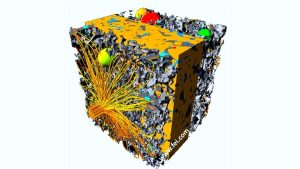 This course does more than calibrate your density log with core grain density and porosity. It starts with conventional core analysis laboratory procedures and the essential core-log integration techniques necessary to create the compatible data sets required for all special core analysis (SCAL) integration. It then describes lab SCAL procedures for static and dynamic geo-models logically and in sequence, integrating SCAL with powerful, modern logs to show how key reservoir parameters are better quantified with SCAL integration. NMR, Dielectric, Cross Dipole sonic, 3D resistivity, Pulsar, Lithoscanner and MDT are some of the logs whose output is cross-calibrated and welded into the fabric of a true, modern, integrated petrophysical evaluation. These evaluations are robust, over-determined and grounded in routine and special core analysis. Integration techniques are explained in practical terms of the question being asked, the physical basis of the core-log data being used and the steps necessary to quantitatively integrate the relevant SCAL with logs and geo-models. Like the author’s other “Integrated Petrophysics” courses a logical, systematic structure is followed which enhances understanding of the where, why and how of modern core-log integration.
Lithology, Porosity, Saturation, Saturation-Height Functions, Absolute and Relative Permeability, Residual Oil Saturation, Natural fractures, FWL, TOC and mechanical properties for brittleness and fracturing are addressed, with the relevant special core and log data identified, explained and then carefully integrated within a logical framework using Interactive Petrophysics software.
Lectures are interleaved with Micro-practicals, videos, PetroDB-WEB demos, practical exercises, class discussions and timely recaps to achieve a dynamic and engaging training session.
This course explains how to perform comprehensive core-log integration on legacy data and arms you with a clear understanding of what is and what is not critical to acquire in your particular reservoir, saving valuable time and money during drilling, completion and development.
Core-Log integration has been the central topic of the author’s Imperial College Ph.D. and over 25 years of consulting, reading and lecturing on core-log integration. It is also the central purpose of the PetroDB-WEB software, which expands essential core-log integration to SCAL and modern logging tools.
Training which can be taken back to the office and used immediately
Course Objectives
- To explain and demonstrate how new and legacy SCAL data can be integrated with conventional and modern logs to create a truly integrated, robust petrophysical evaluation which makes full use of the existing resources at no additional cost
- To explain how to identify and acquire key missing data
- To explain the lab and logging tool processes underlying the data to better understand how to use them quantitatively together. This leads to an understanding of what integration techniques to apply to what special core analysis data.
- To show how to use Interactive Petrophysics software to demonstrate how properly integrated SCAL and modern logs will impact your geo-model results.
Who Should Attend?
Petrophysicists, reservoir engineers, core analysts, geologists and engineers who build or use static or dynamic reservoir models. Anyone with a year’s experience with core-log integration. Bring your laptop with MS Excel.
What You Will Learn
- How to acquire conventional and wireline core data – from mud systems to laboratory
- Special Core Analysis (SCAL) base parameters lab apparatus and explanation
- All major Special Core Analysis (SCAL) lab tests apparatus and explanation
- Major Special Log measurements explained
- The essential techniques of core-log integration
- How to identify the key data channels from modern logs which answer the questions your team is asking
- The questions core-log integration answers that core or log analysis does not
- What integration techniques to apply to what special core analysis data – how to use your data
- How to use legacy core data with the modern log data you have just acquired
- How to use Reservoir Rock Types and PetroDB to estimate core values you do not have
- How to use Interactive Petrophysics software to show how properly integrated SCAL and modern logs will impact your geo-model results
Course Content
- Lab apparatus, process and explanation of Routine and all major Special Core Analysis (SCAL) including:
- Pore Volume Compressibility,
- Archie m, n
- CEC, BQv
- Dean Stark extraction
- Capillary Pressure: Porous Plate, Centrifuge, Mercury Injection
- Interfacial Tension (IFT)
- Wettability Amott, USBM
- NMR T2 cutoff
- Relative Permeability: Steady State, Unsteady State
- Residual Oil Saturation
- Essential core-log integration
- Quality Control of Routine and Special Core Analysis
- How to integrate data with different scales of measurement
- Routine core porosity calibration of density, NMR, neutron and sonic logs
- Routine core permeability calibration of NMR, porosity, HPV… etc
- Routine Dean Stark and other core saturation integration with Resistivity, Saturation-height(s), NMR, Dielecric, Sigma
- Capillary pressure explained
- Lab to reservoir fluid conversions
- How to check and correct lab Pc data
- Reservoir Rock Typing (RRT): Why and how? Facies, NMR, FMI, FZI, HFU. RRT without core.
- Application of RRT during core-log integration
- The engineer’s standalone core based saturation height function
- How to fit Pc data: Foil, J Function, Lambda, Skelt Harrison
- Integrating core saturation height functions with logs: Resistivity, NMR, Porosity, Sigma, MDT
- SCAL electrical properties CEC, m and n: use, abuse and correct implementation
- Using RCA, SCAL and modern logs to solve the low resistivity pay problem
- SCAL NMR lab tests: BFV, T2, T1 cutoffs, Qv experimental technique and results
- Integration of SCAL NMR with logs, use, abuse and alternatives compared
- SCAL Relative Permeability tests: steady vs. unsteady state
- Integration of SCAL rel. perm data with log analysis for kw, ko and kg. Fractional flow
- Do your results concur with field observation? Calibration
- Wettability: impact on capillary pressure, relative permeability and Sor
- Is your reservoir non-strongly water wet? What to do in the lab. What to do during integration.
- Reducing Residual Oil Saturation
- Daily Interactive Petrophysics (IP) and PetroDB-WEB demos
- Excel Petrophysical Toolbox: All workshops, equations, evaluation templates
Instructor CV
Mark Deakin is a technical consultant, author and course instructor in Petrophysical Data Integration. He holds a Ph.D. in ‘Integrated Petrophysics’ from London’s Imperial College, is an ex Amoco petrophysicist and has over 30 years’ experience including as a course instructor with PetroSkills and HOT Engineering. He has performed over 70 detailed reservoir studies worldwide; primarily in Southeast Asia’s low-contrast pay and carbonate reservoirs. Deakin’s proven approach is to identify and rank reserves uncertainties for operators and investors, then guide operators towards defensible booked reserves via the application of new technology, targeted data acquisition and the systematic, logical integration of all related data. After his PhD Deakin authored the first public Integrated Petrophysics course in 1989 which evolved into IPRC, the industry’s benchmark petrophysics training course. This was followed by courses on Carbonate & Fracture Petrophysics IPCFR and focused modules on Quick Look Techniques IPQL, Using Modern Logs with SCAL IPSCAL, Low Resistivity Pay IPLAM, Saturation Height IPSWHT, Using PetroDB Effectively IPPetroDB and Renewable Energy REP.
Deakin’s core interest is the integration of diverse technologies to solve problems. Integration of the uniquely powerful PetroDB, cross-linked core-log-test database, with mainstream software is his current project. Deakin is an active member of SPWLA and occasional lecturer at Edit Cowan & Curtin University. His consulting company PETROPHYSICS Pty Ltd has offices in Perth, Australia and he has homes in Perth and London.