

Overview
Public face to face and online courses 5 days. In-house courses may be amalgamated with other courses and delivered as 3 to 5 day courses however this should be done with caution.
IPSWHT slide example | Testimonials
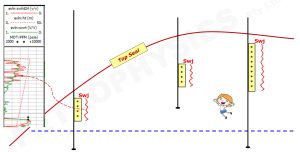 This comprehensive course explains how to derive and use capillary pressure saturation height functions in your daily petrophysical work and how to incorporate them seamlessly into your default evaluations. All aspects of saturation height are covered in detail including the core-log prerequisites, selecting samples, lab corrections, fitting the lab saturation-height function, avoiding common mistakes and how to apply the function to the reservoir with core or logs. The porous plate, centrifuge, air-brine, oil-brine, drainage and imbibition lab procedures are explained and contrasted with mercury injection (MICP) to understand their different applications. Reservoir Types and Reservoir Rock Types, including complex vuggy carbonates and laminates are included.
All commonly used fitting functions are explained and worked through and their applications discussed from the simple FOIL (BVW) to the author’s Modified J as well as Lambda, Skelt-Harrison, Brooks Corey and Thomeer. Excel Solver fitting techniques and check plots are shown to ensure precise functions. Two long, detailed, step-by-step workshops, from lab to reservoir HPV, are an important backbone to this course. The workshops provide participants with a simple, reusable saturation-height templates which they have developed themselves and understand. Following derivation of the SCAL function the practical goes on to determine the problematic reservoir IFTcosTheta and to fully integrate each routine core analysis plug’s reservoir J value with logged resistivity – a unique feature of this course. This process produces a modern, cross-calibrated, real-world integrated petrophysical model from the {SCAL – RCA – Log driven} equation for use in the geo-model, or well, by any team member, geo-modeler, reservoir engineer or petrophysicist. A {Lab > Logs > RCA > FWL > Swht > HPV} sensitivities equation chain is then used to interrogate all inputs, including IFTcosθ. This exhaustive petrophysical model can be quickly re-run using log analysis, or directly within geo-models by varying any variable including FWL, IFT, θ, Fluid densities, rhob, rhog, facies, porosity, k etc. Integrating the saturation height model with RCA and resistivity logs in this manner – so the full model can be quickly re-run by anyone – provides a uniquely powerful and transparent quality control which focuses on key uncertainties and harmonizes team thinking from geologist to engineer.
Thin beds and complex carbonate pore systems are covered with thin sections, SEMs and image logs to address real-world saturation-height issues which are usually glossed over, including how to properly model IFTcosTheta, vugs, fractures, wettability and viscous oil/tar. Pore throat radius calculations and estimates from poroperm plots are included and the impact of complex bimodal pore systems on Swi and Sor is shown and explained.
A similar process is then outlined, but this time deriving the [por-Sw-k-height] relationship from resistivity or NMR logs – a method employed where the petrophysicist believes logs reveal the true reservoir saturation more properly than the available core. The course shows how the full NMR T2 spectrum can be used to create a robust, calibrated saturation-height model, far superior to the standard reservoir engineering porosity band method.
Applications include: – common use equation set for geo model and petrophysics; core-log n; thin bed shaly sands; vuggy carbonates; missed/bypassed pay and tracking OWC rise.
This course is integration! Core-Log integration has been the central topic of the author’s Imperial College Ph.D. and over 35 years of technical consulting, reading and lecturing on core-log integration. It is also the central purpose of the AI assisted PetroDB software which expands essential core-log integration to SCAL and modern logs.
Explains the industry wide saturation-height method and shows how to derive and integrate ALL routine core plugs and logs correctly for a SCAL, NMR or log based capillary pressure saturation height function
Who Should Attend?
Petrophysicists, geo-modelers, reservoir engineers, core analysts, geologists and engineers who build or use static or dynamic reservoir models. Anyone with a year’s experience with core-log integration. Bring your laptop with MS Excel.
Course Outline
- Why Saturation Height functions are necessary and the Essential Pre-requisites for their determination and geomodel application
- Reservoir Types and Reservoir Rock Types: their function and equation sets
- Acquiring Lab Pc data: how to select optimal samples for each Rock Type
- Pc Lab Experiments: Porous Plate, Centrifuge, Mercury (MICP). Primary Drainage and Imbibition
- Which Experiment? Porous Pate, Centrifuge or Mercury?
- Lab data corrections
- Vetting results. When and How we need to combine experimental results
- Explanation of how we get a Pc-Sw curve from centrifuge data (this is complicated!)
- Swht quicklook: no function required just lab results
- All major Fit Functions: Foil, J, Modified J, Lambda, Thomeer, Brooks Corey, Skelt Harrison, EQR
- Fitting functions practicals
- Converting and locating the function from lab to reservoir
- How to use every single RCA plug, not crossplot averages. How to integrate resistivity properly
- Log based Swht functions: When, which logs and how: NMR, Dielectric, Resistivity
- Applications: Petrophysics < = > Geomodel common use equation sets
- Thin Bed Shaly Sands
- Vuggy Carbonates – what to do
- Tar / Bitumen – what to do
- Fractures: how to apply the correct Matrix function
- OWC rise and geo-model updates
- Example on Interactive Petrophysics software
- Wrap Up: Do This, Don’t Do That !
Instructor
Mark Deakin is a technical consultant, author and course instructor in Petrophysical Data Integration. He holds a Ph.D. in ‘Integrated Petrophysics’ from London’s Imperial College, is an ex Amoco petrophysicist and has over 35 years’ experience including as a course instructor with PetroSkills and HOT Engineering. He has performed over 70 detailed reservoir studies worldwide; primarily in Southeast Asia’s low-contrast pay and carbonate reservoirs. Deakin’s proven approach is to identify and rank reserves uncertainties for operators and investors, then guide operators towards defensible booked reserves via the application of new technology, targeted data acquisition and the systematic, logical integration of all related data. After his PhD Deakin authored the first public Integrated Petrophysics course in 1989 which evolved into IPRC, the industry’s benchmark petrophysics training course. This was followed by courses on Carbonate & Fracture Petrophysics IPCFR and focused modules on Quick Look Techniques IPQL, Using Modern Logs with SCAL IPSCAL, Low Resistivity Pay IPLAM, Saturation Height IPSWHT, Using PetroDB Effectively IPPetroDB and Renewable Energy REP.
Deakin’s core interest is the integration of diverse technologies to solve problems. Integration of the uniquely powerful PetroDB, cross-linked core-log-test database, with mainstream software is his current project. Deakin is an active member of SPWLA and occasional lecturer at Edit Cowan & Curtin University. His consulting company PETROPHYSICS Pty Ltd has offices in Perth, Australia and he has homes in Perth and London.
PS: This course for Benchmark Petrophysics training
Who Will Attend
Petrophysicists, geo-modelers, reservoir engineers, core analysts, geologists and engineers who build or use static or dynamic reservoir models. Anyone with a year’s experience with core-log integration. Bring your laptop with MS Excel.
Note: The absolute minimum time for this course is 3 days but this is not recommended. In-house 5 days is preferable with time for exercises/practicals and an emphasis on topics of special interest to the client for example, shaly sands, carbonate vugs, tar, wettability, fractures, common use rock type equations sets etc.