

Explains the industry wide saturation-height method and shows how to derive and integrate ALL routine core plugs and logs correctly for a SCAL, NMR or log based robust capillary pressure Saturation-Height Function
Contents 5 Day
Logging on to this course
Other courses by Deakin, PETROPHYSICS Pty Ltd..
Daily Schedule
Intro: our petrophysical objective..
Course Objectives
Intro: Reservoir schematic (initial conditions)
Intro: Pre-emptive action for Badhole
Intro: What we need to know, everywhere in our reservoir
Intro: Conventional Core Analysis (CCA) – what we get
Intro: Core Cleaning and Drying
Intro: Gas expansion porosity Boyle’s Law Porosimeter
Intro: Why core data rules
Special Core Analysis – what we get
What Special core with what Special Log gives what Special answer?
MICROPRACTICAL Select the mud, core, log and lab test requirements for an optimal Swht evaluation
Pre-requisties: Even in good quality reservoir porosity error is amplified via Sw, k and Netpay
WHY Saturation Height (Swht)
WHAT is Capillary Pressure (Pc)
Lab to Reservoir: Initial conditions capillary pressure does not depend upon rock quality – Pc is created by buoyancy
Swht is IMPORTANT!
DAY1 Practical
Which Pc-Sw curve?
Determine FWL
Pc: WFTs provide FWL, Ht, Pc=0: Actual Reservoir Capillary Pressure, Height above free water level & Mobile Fluid Type
Pc: Excess Pressure = Capillary Pressure
The Hydrophilic Logging Tool : 2 pressures, One depth à FWL à Swht
MICROPRACTICAL. FWL from single WFT point
What is Capillary Pressure?
Swpc: Capillary Pressure, wetting phase (water) saturation decreases with increasing Pc
Swpc: Poor Reservoir Qualities retain more water and have thick Transition Zones
Capillary Pressure Saturations – 4 controls on Sh
Lab àReservoir – what height gives the same Sw as the Pc in your lab function? (not the same Pc, the same Sw)
You will need Swht during log analysis if..
Sw log analysis (Swrt) Uncertainty Increased by
..which add value to Swht
Non Archie conditions complicate Swrt
..which adds value to Swht
Is Swht better than Swrt? Malay Basin shaly sands
MICROPRACTICAL
Swht modelling should use SCAL, RCA, Logs and possibly seismic to populate the geo model
ESSENTIAL PRE-REQUISITES
Swht pre-requisites: Applying Swht via RCA requires machine sampled (whole rock) RCA
Swht Lab Prep: Consider cutting rotary side-wall cores after main HPV units have been identified to improve log inputs
Swht pre-requisites: RCA
Swht pre-requisites: Core–Log Equality, Machine Sampled RCA
Swht pre-requisites: for Integration: Core = Log
Swht pre-requisites: Reservoir Types: Petrophysical Data Acquisition for Swht fails if..
END DAY 1
DAY Practical
Day1 Recap
Swht Lab Prep: RCA, typical laboratory process
Swht Lab Prep: The same cleaning & drying for SCAL & RCA
Swht Lab Prep: correct your RCA to Overburden Porosity Uniaxial Compaction Correction
Swht Lab Prep: Overburden Porosity simple but often wrong, check yours.
This software package demo well is wrong! Core=24, Log=22
Swht : Porosity measurements compared
MICROPRACTICAL – Matrix porosity Error in tight carbonates
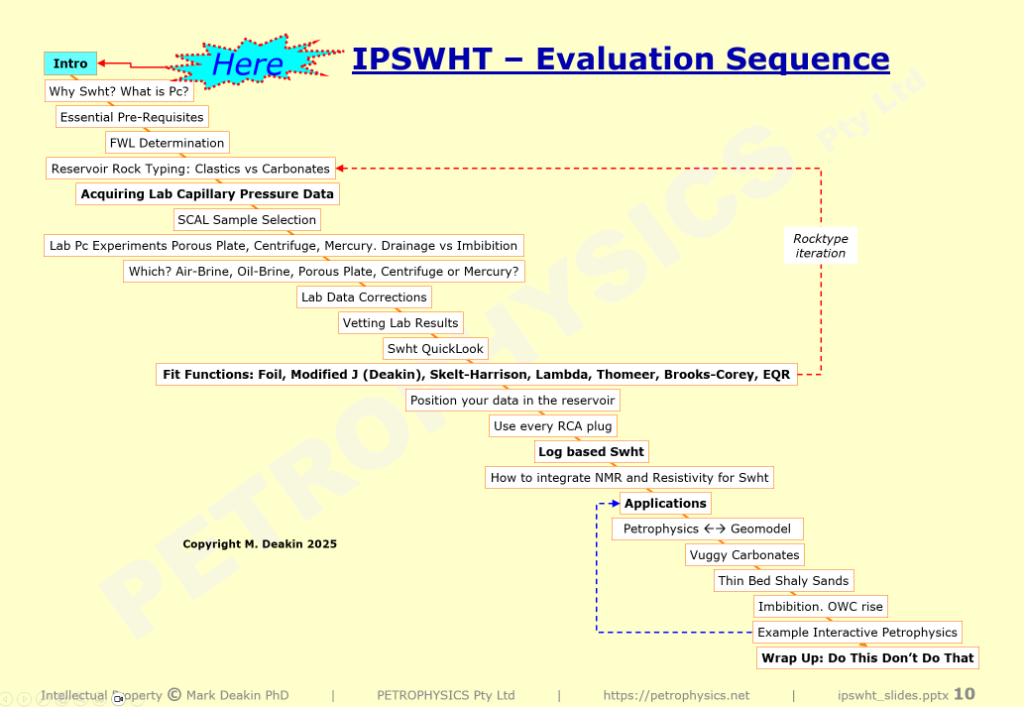
IPSWHT – Evaluation Sequence
RESERVOIR TYPES and RESERVOIR ROCK TYPES
What is your Petrophysical Reservoir Type?
What is your Reservoir Type? Contd..
What is your Reservoir Type? Contd..
RESERVOIR ROCK TYPES (RRTs)
Reservoir Rock Typing (RRT) for Swht – Process 1, 2, 3
Reservoir Rock Typing (RRT) for Swht
RRT for Swht
Data should cover cores and logs
RRT for Swht: Why you need Rock Typing or use BVH for k
RRT for Swht contd.. Carbonate cautions
RRT for Swht – carbonate reality can be complex!
RRT for Swht contd..
RRT for Swht: mercury injection data reveals PTSD
RRT for Swht: vugs often invalidate Swht calculations. Why?
Reservoir Rock Typing for Swht – Try J trends first
The Swht Function: cornerstone of the Reservoir Rock Type Equation Set
Summary – Reservoir Rock Typing for Swht
DAY Practical
IPSWHT – Evaluation Sequence
ACQUIRING LABORATORY CAPILLARY PRESSURE DATA
SCAL Sample Selection and Apparatus
Swht Lab Prep: is core Fit for Purpose?
Swht Lab Prep: sample selection for a given Pc high Surface Area rocks retain more water
Swht Lab Prep: How NOT to pick SCAL plugs: Are Pc Plugs Representative? Have Anomalous plugs been identified?
Swht Lab Prep: How to pick SCAL plugs
Swht Lab Prep: Are you creating misleading input data?
MICROPRACTICAL
Hydrocarbon Pore Volume indicates permeability Chart K-4
Porous plate apparatus ..the gold standard
Porous plate: theory, simple
Porous plate: core overburden Pc & electrical properties
Porous plate: Problems and Advantages
END DAY 2
DAY Practical
Day2 Recap
Day2 Recap contd..
Centrifuge: apparatus
Centrifuge: RPM à Pressure (force per area)
Centrifuge: Process1
Centrifuge: Process2
Centrifuge: Process3 Centrifuge theory – complicated!
Centrifuge: Sw distribution – observed not calculated
A Centrifuge sample is like a mini-reservoir with a steep Pc-Sw gradient
Centrifuge: Problems and Advantages
Mercury: apparatus, small irregular samples
Mercury: apparatus, regular core plugs
Mercury: Process
Mercury: Theory. Each Pc has a corresponding Pore Throat Radius
Mercury: problems and advantages
What height is 200psi Pc lab equivalent to?
MICROPRACTICAL Which Lab Pc experiment do you prefer and why?
IPSWHT – Evaluation Sequence
Lab Data Corrections
Lab Corrections: Lab data corrections, order
Lab Corrections: Mercury Closure/conformance
Lab Corrections: Mercury Pe and Pd
Lab Corrections: Reservoir overburden stress (all data)
Lab Corrections: Mercury, Clay Bound Water correction
Lab Corrections: Mercury capillary pressure data correction for ClayBW only
Lab corrections: What happens if you don’t correct Mercury?
DAY Practical
Mercury data corrections
Lab Corrections: What is the Capillary End Effect (CEE)? Centrifuge only
Lab Corrections: CEE corrections
Lab Recommended Practice to reduce CEE
Vetting Lab results: basic questions
Vetting Lab results: Porous Plate
Vetting Lab results: Centrifuge
Vett lab results: Is stress vs compaction smooth?
Vett lab results: Is Sw vs J or Pc smooth?
Vetting Lab results: Mercury
Vett lab results: Is k vs Displacement Pressure (Pd) on trend?
Vett lab results: Is RQI vs Swi on trend?
Swht QUICKLOOK (pre Function fit)
Swht Quicklook: arrange your lab Pc data like this
Swht quicklook: Redisplay lab Pc results as a simple Sw-Ht grid
Swht: Capillary Pressure Saturations may be inaccurate
Swht quicklook: Does Swht = Swik4? kair from log derived Ø & Sw irreducible, Chart K4
END DAY 3
DAY3 Practical
Quick Look Swht methods
Day3 Recap
IPSWHT – Evaluation Sequence
HOW TO DERIVE A LABORATORY BASED CAPILLARY PRESSURE SATURATION HEIGHT FUNCTION
Fit Functions
BVW FOIL Function – Bulk Volume Water, a simple function of Height (Pc) ?
BVW FOIL Function – easy to understand and use IF one rock type
BVW FOIL Function – process..
MICROPRACTICAL Core analysis indicates Swi
Modified J – Deakin. What is J?
Modified J – Deakin J collapses diverse samples onto one trend
Modified J – Deakin. What is J? Summary
Modified J – Deakin, lab data, observe Jsw1
Modified J – Deakin, lab data fit J-Sw Swj
Modified J – Summary Process for Swj
Modified J – Deakin, key check plots
Modified J example
Sw & HPV predicted by Swj vs core plug Sw_msrd
Modified J – Rock typing with J for geo-models, J Types
Modifed J – Can logs identify your RTypes or JTypes?
Logs could not identify these two trends so the average was used
Modified J – summary schematic SPE39761
DAY Practical
How to Use Capillary Pressure Data
MICROPRACTICAL Sw: Calculate Swi_nmr from Free Fluid and Øt. What assumptions have you made?
Skelt-Harrison
Skelt Harrison – process
Brooks Corey
Lambda
Thomeer Analysis Carbonate MICP data
Pore Throat Size Distribution, Rock Typing, Sw
Thomeer Equation Parameters
Determine bvmax, Pd, G for each pore system
Function Summary For use in petrophysics and geo-model software
IPSWHT – Evaluation Sequence
POSITION YOUR LAB RESULTS INTO THE RESERVOIR
Lab à Reservoir – to position your lab function into the reservoir the Pc=0, FWL must be estimated
Lab à Reservoir – what height gives the same Sw as the Pc in your lab function? (not the same Pc, the same Sw)
Lab à Reservoir – IFT*cosq uncertain especially water drive, oil
Lower Interfacial Tension IFT= Increased HPV
Lab à Reservoir – IFT typical values
Lab à Reservoir: Is your reservoir non strongly water wet? ..especially water drive oil?
Lab à Reservoir: Wetting preferences dictate the amount and distribution of oil and water within the pore network
Wettability – is oil or water attracted to the rock?
DAY4 Practical: How to Use Capillary Pressure Data
Lab à Reservoir: Is your reservoir non-strongly water wet?
Lab à Reservoir – oil, mixed and oil wet. When..?
Lab à Reservoir : now we know height we know J.. for every plug
Lab à Reservoir – J gives every RCA plug has its own Sw, Swj
Swht integration:
Log Ø, Sw, k = Core Ø, Sw, k
END DAY 4
DAY Practical
xx Day4 Recap
c:\data\courses\zzMRIL.avi Click to play
Something to think about.. Do perched water contacts violate capillary pressure Saturation-height assumptions?
IPSWHT – Evaluation Sequence
HOW TO DERIVE A LOG BASED SATURATION HEIGHT FUNCTION
Different options for log based Swht functions
Log-based Swht Functions without Sw logs input 1)
Log-based Swht Functions without Sw logs input 2)
Lucia’s Carbonate generic Swht functions, interparticle porosity
Swht Sensitivites xls. How does each input affect BVH? Powerful
Log Based Saturation Height Functions
Resistivity Based Functions
Log-based Swht: Resistivity log Swht functions
Log-based Swht: Typical causes of Swht≠Swrt
Log based Swht – Reconcile and improve with Swlogs
Log Based Saturation Height Functions
Volume Based Log Functions
Volume log methods
Volume log Swht – Magnetic Resonance Swi
NMR Swht – Each T2 bin, is a Pc bin, is a Ht bin so… bins fill with increasing Ht
Volume log Swht – NMR, think Swht
Log-based Swht functions – Careful with vugs & BVH! Can NMR find vugs?
Vugs, Swht and HPV
Lab to Reservoir: Swrt agrees with Swht
Log-based Swht functions – Ecoscope, Sigma BVW saline, microporous carbonates
Swht equation chain sensitivities xls – Locate feasible error
IPSWHT – Evaluation Sequence
Swht APPLICATIONS: SOME USES OF CAPILLARY PRESSURE SATURATION HEIGHT FUNCTIONS
J Type iteration: J value vs. Sw trends can be used to define separate rocktypes (J Types), a practical approach
Applications: Core-Log n
Swht application – how to use Swht to calibrate logs
Core-log common format ‘n’ definition plot
Swht application – how to use Swht to calibrate logs.
Use Swht on the Core-log common format ‘n’ definition plot
Swht: Capillary Pressure Sw and ‘n’
Swht summary SCAL à RCA à Logs à HPV This is integration!
Swht application: This facies dismissed by buyer until rigorous Swht was applied
Net: Logs = non-pay or marginal, core = pay: Tested 11mmscfpd. This facies 35% Bulk Rock Vol.
Swht: One Common Use Equation Set. Log and Geo-model HPVs, kabs, koil. Core = Log = Geomodel (black)
Applications: Geo model
Geo-model: A Consistent Geo.model
Applications: OWC rise
Saturation height users:
Systematic errors which ruin your geo.models (chronological)
END
BACKUP