
What it is
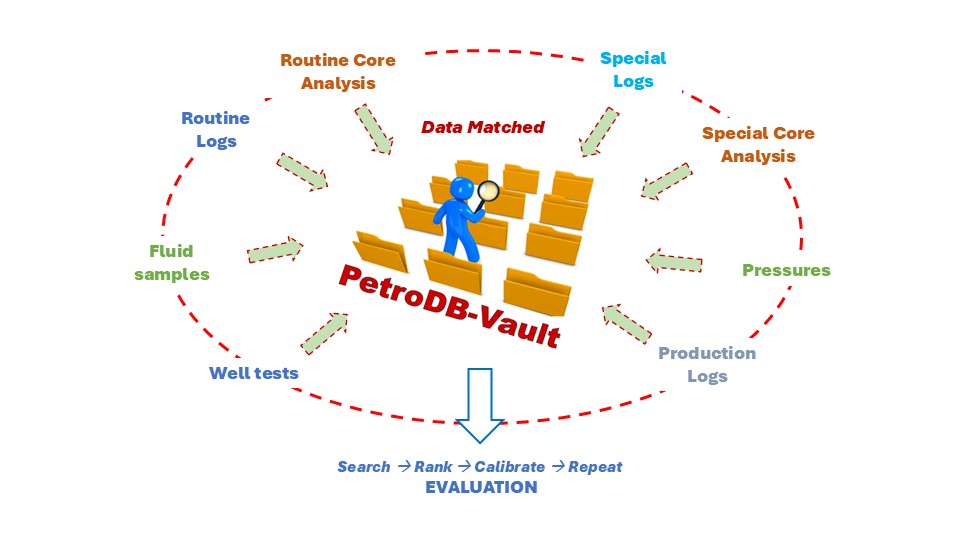
PetroDB-Vault combines two assets:
PetroDB; a calibrated database of real laboratory core and special-core-analysis measurements Vault; a transparent interpretation engine encoding rock-type-specific relationships built over 35+ years of global reservoir studies.
Together they calibrate a well’s logs against hard, measured data — not assumptions.
The problem it solves
Most field-development decisions rest on interpretations from a handful of wells, made with generic equations and little calibration to real rock. The cost of getting it wrong is measured in billions.
Conventional evaluation software is an empty engine: it produces one answer and hides its workings. PetroDB-Vault does the opposite — it shows every choice, calibrates each step to the best available measurement, and lets the expert challenge or override anything.
How it's different
Calibrated to real data
Every interpretation is anchored to measured core and SCAL values, not defaults.
Transparent, not a black box
Every parameter, source and decision is recorded and reviewable.
Three parallel evaluations in one run
Database-driven, petrophysicist-driven, and AI-assisted evaluations are compared side by side, with the expert choosing or blending the result.
Expert in control
The petrophysicist can force any input, in any zone, at any step. Automation with judgment, never instead of it.
Runs where your data lives
Operates inside your existing petrophysics platform; nothing leaves your environment.
Who it's for
Petrophysicists
A faster, calibrated, fully auditable evaluation they can defend line by line.
Geologists & reservoir teams
Consistent, rock-typed interpretations that tie to the geological model.
Management
De-risked field-development decisions, with a clear evidence trail behind every number.
See PetroDB-Vault in action
Discover how calibrated data, transparent interpretation and expert control can strengthen your well evaluations.
Technical overview
Core-quality evaluations from ordinary logs.
PetroDB-Vault brings decades of calibrated measurement data to bear on every well, producing the kind of confident, evidence-based interpretation that has traditionally required extensive coring and testing — automatically, transparently, and under the petrophysicist’s full control.
The problem it addresses
Most field-development decisions rest on interpretations from a handful of wells, built on generic equations and calibrated to little real rock. Default cementation and saturation exponents, assumed grain densities, uncalibrated permeability transforms — each is a reasonable guess, and each compounds. In reservoirs where a single decision carries a billion-dollar consequence, “reasonable guess” is an expensive foundation.
PetroDB-Vault replaces assumption with measurement. Every interpretation is anchored to real laboratory core and special-core-analysis data, matched to the rock actually being evaluated.
What sits behind it
PetroDB — a curated, rock-typed database of tens of thousands of calibrated laboratory measurements: porosity, permeability, grain density, capillary pressure, electrical properties and saturation, drawn from decades of reservoir studies across a wide range of lithologies and basins. Every measurement carries its provenance and its measurement conditions, so like is compared with like — stressed against stressed, ambient noted as ambient.
Vault — an interpretation engine encoding the diagnostic workflows developed over 35 years of consulting and refined across more than 70 reservoir studies. It draws candidate parameters from the calibrated data, evaluates them on merit against the rock at hand, and delivers a calibrated result the petrophysicist can inspect, challenge, and override at any point.
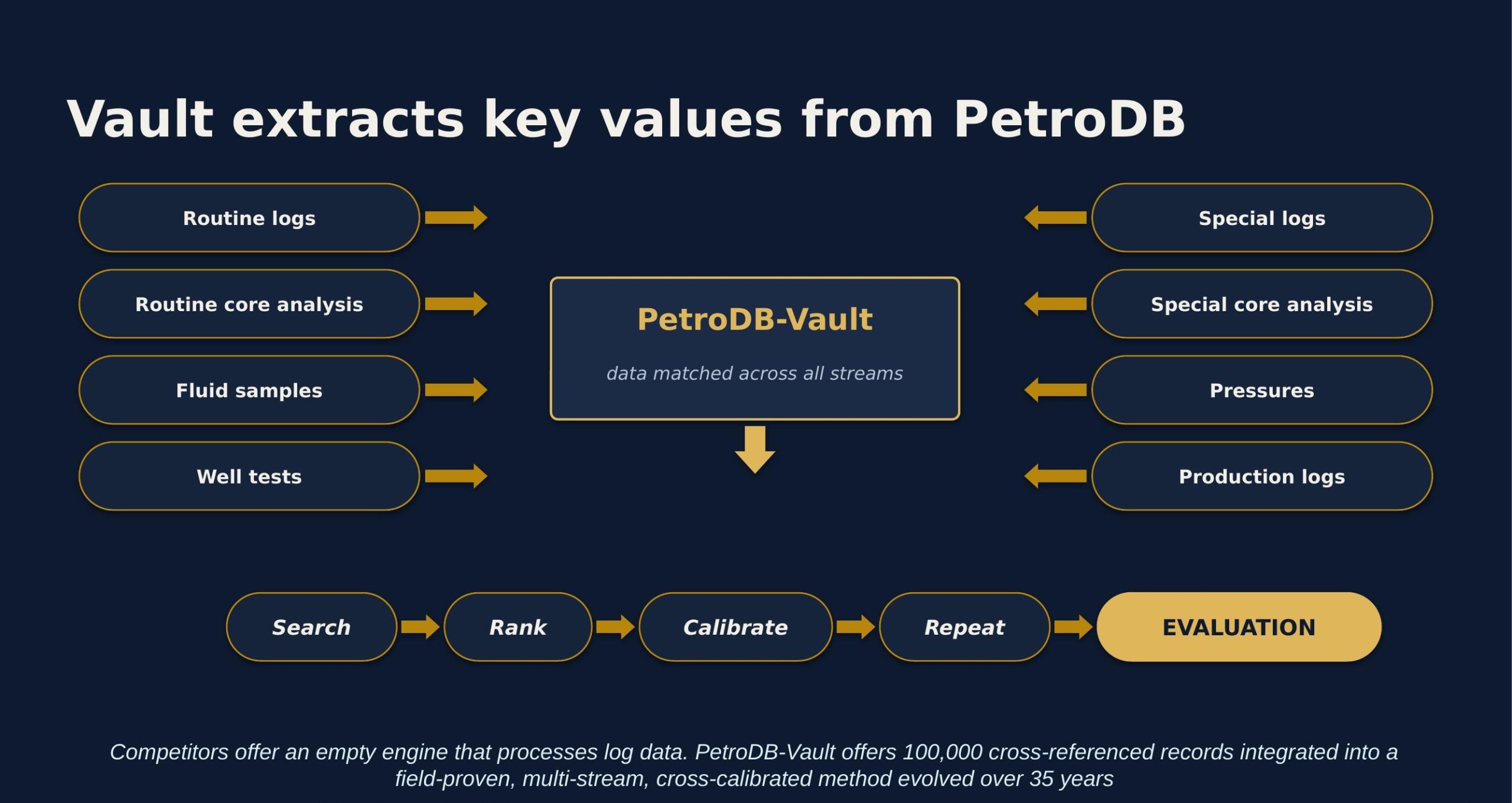
The two together do something conventional software does not: they calibrate a well’s logs against hard, measured data rather than against defaults — and they show their reasoning while doing it.
How it differs from conventional evaluation
- Calibrated, not assumed. Parameters are anchored to measured core and SCAL, matched by rock type — not to textbook defaults.
- Transparent, not black-box. Every parameter, its source, and the basis for its selection are recorded and reviewable. The petrophysicist sees why each value was chosen.
- Expert-controlled. Any input can be forced, in any zone, at any step. The engine accelerates judgment; it never replaces it.
- Multi-disciplinary by design. Logs, core, SCAL, pressures, tests and fluid data are integrated into one coherent evaluation rather than interpreted in isolation.
- Secure by architecture. It runs inside your existing petrophysics platform. The database is sealed and encrypted; nothing of the reference data or the method leaves your environment, and your well data never leaves it either.
What it delivers
Faster evaluations, defensible line by line. Consistent, rock-typed interpretations that tie to the geological model. Calibrated permeability, saturation and porosity with the measured evidence standing behind each number — and a clear audit trail from raw log to final answer. For the asset team, that means fewer surprises between prognosis and outcome. For management, a de-risked decision with the evidence to support it.
Provenance
The methodology traces to post-doctoral work begun in 1995 and has evolved through three decades of active consulting — its evaluations treated as the benchmark by the operators who commissioned them. It is now implemented in a modern, auditable form and built to run inside industry-standard petrophysical software.