

Overview
Public face to face and online courses 5 days. In-house courses may be amalgamated with other courses and delivered as 3 to 5 day courses however this should be done with caution.
IPRC slide example | Testimonials
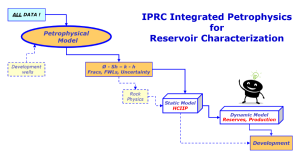 This course will teach you how to evaluate reservoirs and quickly identify flawed results. Robust reserves and simulation are achieved by the logical, systematic integration of all relevant data. A quality interpretation is extremely cost-effective compared with development mistakes and essential with today’s complex data sets. Proper core-log-test integration replaces the need to run expensive, irrelevant logs, explains data conflicts and provides the correct answer faster, strengthening your position as an operator and petrophysicist. By contrast, stand-alone log analysis results in wrong decisions and weakens your position as a competent petrophysicist. This course, evolved over 35 years of technical petrophysical consulting and training, demonstrates how robust answers are achieved by the logical integration of core, special core, pressures, well-tests and other diverse data. Pay and reserves are addressed first by Quick Look Log Analysis and then by a disciplined, logical process to optimize the interpretation of lithology, porosity, saturation, permeability and fluid contacts – the basis of Reserves. Low Contrast Pay, clastics and carbonates are evaluated by straight forward integration techniques which outperform log analysis with direct, plain to see results. The integration of mudlogs, LWD, wireline, facies/rock types, core, SCAL, NMR, dielectric, MDTs and well tests are explained via the author’s 30,000 core plug PetroDB and Interactive Petrophysics (IP) software. Finally, the critical Petrophysics to Geomodel Essential Checks are clearly set out.
This course is a condensed package of powerful integration techniques. It uses an interleaved sequence of lectures, micro-practicals, PetroDB demos, micro-practicals, movies and workshops to convey a flexible and integrated petrophysical method. It’s highly regarded and continually updated, 344 page “Course Notes” has provided the benchmark mainstream petrophysics textbook for over 35 years. This was the first public petrophysics integration course (Jan-1990) and remains..
The Benchmark Petrophysics Course Today!
Do not be fooled by imitations
Who Should Attend?
Petrophysicists, geologists, operations geologists, geo-modellers, reservoir engineers, geophysicists, core analysts or anyone with a year’s experience with logs or formation evaluation. Bring your laptop with MS Excel.
Course Outline
- Petrophysical objectives. Physics vs. petrophysics. Concepts of data hierarchy and calibrations
- Quick Look Operations log analysis. Logging tool review. Vshale & lithology; complex lithology.
- Porosity: Total or Effective? Gas zones and complex lithologies; calibrating porosity
- Sw100 zones and Rwa’s: Their derivation and effective use
- Sw: Improving the inputs which really matter: Rt/Ro, Rw, m, n, Sw: OBM/WBM core; Capillary pressure & Saturation-Height models; NMR Sw’s; Facies and wettability defined, explained and integrated. Calibrating Sw
- Shaly sands: Defined & explained. Integrating resistivity & non-resistivity data; FMI/NMR/Pc, WaxmanSmits Qv, m*, n* with or without core
- Fluid contacts and capillary pressure: Using MDTs effectively. Distinguishing the mobile phase
- The RockType Master Equation: What is it? How do I use it?
- Permeability: Rock-types; NMR; Conventional log quicklook permeability; Bound fluid volume; Timur-Coates permeability; Effective permeability kwtr, koil, kgas and their SwP10, P90 sensitivities; Calibrating log derived effective permeability’s with well test kh; What is it and how do I deliver the correct permeability reservoir simulation input
- Netpay: What is netpay? Definition. It’s proper criteria and evaluation
- Key recommendations for mud, drilling, logs, core analysis, Sw & k evaluation
- 10 common systematic errors which ruin geological models
- Daily Interactive Petrophysics and PetroDB-WEB demos.
- Excel Petrophysical Toolbox: All workshops, Swpc:n calibration, Shaly Sand QL LAS evaluator, 100+ Eqns, PetroDB-Vault extracts, HPV Sensitivities.
Instructor
Mark Deakin is a technical consultant, author and course instructor in Petrophysical Data Integration. He holds a Ph.D. in ‘Integrated Petrophysics’ from London’s Imperial College, is an ex Amoco petrophysicist and has over 35 years’ experience including as a course instructor with PetroSkills and HOT Engineering. He has performed over 70 detailed reservoir studies worldwide; primarily in Southeast Asia’s low-contrast pay and carbonate reservoirs. Deakin’s proven approach is to identify and rank reserves uncertainties for operators and investors, then guide operators towards defensible booked reserves via the application of new technology, targeted data acquisition and the systematic, logical integration of all related data. After his PhD Deakin authored the first public Integrated Petrophysics course in 1989 which evolved into IPRC, the industry’s benchmark petrophysics training course. This was followed by courses on Carbonate & Fracture Petrophysics IPCFR and focused modules on Quick Look Techniques IPQL, Using Modern Logs with SCAL IPSCAL, Low Resistivity Pay IPLAM, Saturation Height IPSWHT, Using PetroDB Effectively IPPetroDB and Renewable Energy REP.
Deakin’s core interest is the integration of diverse technologies to solve problems. Integration of the uniquely powerful PetroDB, cross-linked core-log-test database, with mainstream software is his current project. Deakin is an active member of SPWLA and occasional lecturer at Edit Cowan & Curtin University. His consulting company PETROPHYSICS Pty Ltd has offices in Perth, Australia and he has homes in Perth and London.
PS: This course for Benchmark Petrophysics training
Who Will Attend
Petrophysicists, geologists, operations geologists, geo-modellers, reservoir engineers, geophysicists, core analysts or anyone with a year’s experience with logs or formation evaluation. Bring your laptop with MS Excel.