

Overview
Public face to face and online courses 5 days. In-house courses may be amalgamated with other courses and delivered as 3 to 5 day courses however this should be done with caution.
IPSCAL slide example | Testimonials
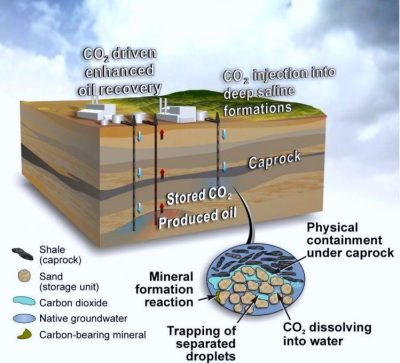 To understand the context, objectives, lab experiments and application of Routine and Special Core Analysis for Petroleum EOR and CO2 Carbon Capture (CCS, CCUS) projects. To integrate and apply these data with routine and modern logs, including Stress and NMR, for optimal geo-models and reservoir management, with or without CO2 storage.
The course follows a chronological sequence starting with the essential reservoir characteristics required for EOR and long-term Carbon storage and their ranking criteria, from produced hydrocarbon reservoirs to deep saline aquifers, clastic and carbonate. The RCA and SCAL sample selection, lab experiments and how CO2 injection alters SCAL parameters is followed by how to integrate modern logs with this data in the subsurface.
Course Objectives
- To understand the different requirements of CCS reservoir management from oil and gas reservoirs and to pinpoint the common errors and assumptions that must be properly addressed if optimal decisions are to be made during appraisal and ongoing CCS management. To highlight the data which is critical to acquire and their role in CCS projects.
Who Should Attend?
Petrophysicists, reservoir engineers, core analysts, geologists and engineers who build or use static or dynamic reservoir models. Anyone with a year’s experience with core-log integration. Bring your laptop with MS Excel.
Course Outline
To understand the context, objectives, lab experiments and application of Routine and Special Core Analysis for Petroleum EOR and CO2 Carbon Capture (CCS, CCUS) projects. To integrate and apply these data with routine and modern logs, including Stress and NMR, for optimal geo-models and reservoir management, with or without CO2 storage.
Instructor
Mark Deakin is a technical consultant, author and course instructor in Petrophysical Data Integration. He holds a Ph.D. in ‘Integrated Petrophysics’ from London’s Imperial College, is an ex Amoco petrophysicist and has over 30 years’ experience including as a course instructor with PetroSkills and HOT Engineering. He has performed over 70 detailed reservoir studies worldwide; primarily in Southeast Asia’s low-contrast pay and carbonate reservoirs. Deakin’s proven approach is to identify and rank reserves uncertainties for operators and investors, then guide operators towards defensible booked reserves via the application of new technology, targeted data acquisition and the systematic, logical integration of all related data. After his PhD Deakin authored the first public Integrated Petrophysics course in 1989 which evolved into IPRC, the industry’s benchmark petrophysics training course. This was followed by courses on Carbonate & Fracture Petrophysics IPCFR and focused modules on Quick Look Techniques IPQL, Using Modern Logs with SCAL IPSCAL, Low Resistivity Pay IPLAM, Saturation Height IPSWHT, Using PetroDB Effectively IPPetroDB and Renewable Energy REP.
Deakin’s core interest is the integration of diverse technologies to solve problems. Integration of the uniquely powerful PetroDB, cross-linked core-log-test database, with mainstream software is his current project. Deakin is an active member of SPWLA and occasional lecturer at Edit Cowan & Curtin University. His consulting company PETROPHYSICS Pty Ltd has offices in Perth, Australia and he has homes in Perth and London.
PS: This course for Benchmark Petrophysics training
Who Will Attend
Petrophysicists, reservoir engineers, core analysts, geologists and engineers who build or use static or dynamic reservoir models. Anyone with a year’s experience with core-log integration. Bring your laptop with MS Excel.